


Why Calabasas Homeowners Can’t Afford to Ignore Dryer Vent Maintenance
📋 In This Guide
- ▸Recognizing the Warning Signs Your Dryer Vent Needs Immediate Attention
- ▸How Often Should Dryer Vents Be Cleaned in Calabasas Homes?
- ▸Professional Dryer Vent Cleaning Versus DIY: What Homeowners Need to Know
- ▸The Hidden Connection Between Clean Vents, Energy Efficiency, and Dryer Lifespan
- ▸Step-by-Step: What Happens During Professional Dryer Vent Cleaning in Calabasas
With median home values exceeding $1.6 million in neighborhoods like The Oaks of Calabasas and Calabasas Park Estates, protecting your investment means staying ahead of hidden dangers—and few household hazards are as overlooked as clogged dryer vents. Southern California’s year-round dry climate, combined with Santa Ana wind conditions, creates an environment where a simple accumulation of lint can transform into a catastrophic fire risk.
The National Fire Protection Association reports that dryers cause an estimated 15,970 home fires annually, with failure to clean being the leading factor in 34% of these incidents. In affluent communities like Calabasas, where high-efficiency washers paired with premium dryers run multiple loads daily in larger homes, lint accumulation accelerates faster than most homeowners realize. When you’re managing laundry for a family in a 3,000+ square foot home in Mulwood or Calabasas Highlands, that dryer vent isn’t just an appliance component—it’s a critical safety system requiring regular attention.
Our team at ACE Appliance Heating and Cooling responds to dozens of dryer-related service calls throughout ZIP codes 91302, 91301, and 91372 each month. What we consistently find is that most homeowners have never had their vents professionally cleaned, don’t know where the exterior vent terminates, and assume that emptying the lint trap after each load provides adequate protection. It doesn’t.
A clean lint screen only captures 60-70% of lint produced during the drying cycle. The remainder travels through the vent system, adhering to interior walls, bends, and the exterior termination point. In Calabasas homes where dryer vents may extend 25 feet or more from interior laundry rooms to exterior walls, this buildup restricts airflow, forces your dryer to work harder, extends drying times, increases energy consumption, and creates the perfect conditions for ignition.
Recognizing the Warning Signs Your Dryer Vent Needs Immediate Attention
Before a clogged vent leads to a fire, your dryer will communicate distress signals that too many homeowners dismiss as normal wear. Understanding these warning signs can mean the difference between a $150 maintenance service and a five-figure insurance claim.
Extended drying times are the most obvious indicator. If loads that once dried in 40 minutes now require 90 minutes or multiple cycles, lint buildup is restricting exhaust airflow. In Calabasas’s low-humidity environment, properly functioning dryers should complete standard loads efficiently. When they don’t, the problem is almost always ventilation-related, not the dryer itself.
Excessive heat buildup tells you airflow is compromised. Touch the top of your dryer mid-cycle—if it’s uncomfortably hot, or if your laundry room feels like a sauna, trapped heat can’t escape through the vent. This forces the high-limit thermostat to cycle repeatedly, eventually leading to thermal fuse failure. We document this scenario frequently during dryer repair calls in Calabasas, where homeowners report burning smells or complete heating failure.
Visible lint around the exterior vent hood signals restriction. Walk outside and locate where your dryer vents to the exterior—typically on a side wall or the roof. The vent hood should open freely when the dryer runs and close when idle. If you see lint accumulation around the opening, the flapper stuck open, or lint visibly clinging to landscaping nearby, the internal vent is severely clogged.
Musty odors on freshly dried clothes indicate moisture isn’t escaping. When vents can’t expel humid air, moisture condenses inside the duct, creating mold growth and that characteristic mildew smell that transfers to your laundry. This is particularly problematic in Calabasas homes with longer vent runs or multiple 90-degree bends that trap moisture.
The dryer shuts off before clothes are dry because thermal cutoff switches are protecting the unit from overheating. These safety devices detect excessive temperatures caused by restricted airflow and interrupt the heating element. While this prevents fires, it also means your vent system is in critical condition.
If you’re experiencing any combination of these symptoms, don’t wait for the next convenient maintenance window. Contact our team at (818) 939-4882 for same-day diagnostics. What feels like a minor inconvenience may be hours away from becoming a genuine emergency.
How Often Should Dryer Vents Be Cleaned in Calabasas Homes?
The simple answer: at minimum, once annually. The realistic answer for most Calabasas households: every six to nine months, depending on usage patterns, household size, and vent configuration.
The U.S. Fire Administration recommends annual professional cleaning as a baseline, but this guideline assumes average use—approximately 5-7 loads per week in a household of 2-3 people with a relatively short, straight vent run. In our service area, we rarely encounter “average” situations.
Consider the typical scenario in neighborhoods like Park Moderne or the Bird Streets: families of four or five, active lifestyles generating sports uniforms and workout gear, multiple bedrooms with their own bedding, and luxury linens requiring frequent laundering. We routinely service homes running 10-15 loads weekly. At this volume, lint accumulation reaches hazardous levels in 4-6 months, not twelve.
Vent configuration dramatically affects cleaning frequency. A dryer located on an exterior wall with a 4-foot straight run to outside requires less frequent service than a second-story laundry room with a 30-foot vent snaking through walls, making two 90-degree turns before reaching the roof. Each bend, each additional foot of ductwork, each section of flexible rather than rigid metal ducting increases lint trapping and reduces airflow.
Homeowners who use dryer sheets face accelerated buildup. The waxy coating that makes clothes feel soft also coats vent interiors, creating a sticky surface where lint adheres more aggressively. If you prefer dryer sheets over wool balls or liquid fabric softener, plan on more frequent professional cleaning—typically every six months.
Pet owners require enhanced maintenance schedules. Homes with dogs or cats generate significantly more lint and pet hair, even with dedicated pet bedding washes. We recommend quarterly inspections for households with multiple pets, particularly during shedding seasons.
For Calabasas homeowners committed to fire prevention and appliance longevity, we suggest this tiered approach: professional inspection and cleaning every 12 months minimum, with interim DIY checks every three months. Our annual dryer maintenance service covers comprehensive vent cleaning, internal lint removal from the dryer cabinet, and thermal sensor testing—all for a transparent $95 investment that protects assets worth millions.
Professional Dryer Vent Cleaning Versus DIY: What Homeowners Need to Know
YouTube tutorials and home improvement blogs make dryer vent cleaning appear straightforward: disconnect the dryer, insert a brush, sweep out the lint, reconnect. While homeowners can certainly perform basic maintenance between professional services, there’s a substantial difference between superficial cleaning and the thorough decontamination required for fire prevention.
Professional services access the entire vent system, not just the first few feet. Retail vent cleaning kits include flexible brush rods that extend 10-12 feet—adequate for short, straight runs but useless for the typical Calabasas installation where vents travel through walls, transition from flexible to rigid ductwork, and terminate 20-35 feet from the dryer. Our technicians use commercial rotary brush systems with 50-foot capacity, high-volume HEPA vacuums, and video inspection cameras to verify complete lint removal throughout the entire run.
Exterior vent hood condition requires attention most homeowners overlook. The termination point where exhaust exits your home features a flapper or louver designed to prevent pest intrusion while allowing unrestricted airflow. These components corrode, accumulate lint buildup, stick closed, or become damaged by weather and landscaping equipment. During professional service, we clean, lubricate, and verify proper operation—or recommend replacement when deterioration compromises function.
Ductwork integrity assessment prevents future problems. As we clean, we evaluate the entire vent path for code violations, damage, and design issues. Crushed flexible ducts behind dryers, improper use of vinyl or foil accordion-style venting (which hasn’t met code for decades), missing duct joints, and excessive bend counts all contribute to chronic airflow restriction. Identifying these issues allows for correction before they cause dryer failure or fire.
Internal dryer cabinet cleaning removes hidden lint accumulation. Most DIY efforts focus exclusively on the external vent, but lint infiltrates the dryer’s internal cabinet, accumulating on motors, heating elements, thermostats, and structural components. This internal lint presents equal fire risk and requires partial dryer disassembly to access properly. Our comprehensive service includes opening the cabinet, vacuuming all internal surfaces, and inspecting heating components for signs of thermal stress.
That said, homeowners should absolutely perform quarterly basic maintenance between professional services. Disconnect the dryer, vacuum out the short transition duct connecting the appliance to the wall, and inspect the exterior vent hood for obvious blockage. This 20-minute task reduces accumulation and extends the time between professional cleanings without requiring specialized equipment.
For complex installations, homes with chronic airflow issues, or whenever you’re uncertain about vent condition, professional service isn’t optional—it’s essential fire prevention. Our Calabasas appliance service team has cleaned thousands of dryer vents across local neighborhoods, and we consistently find hazardous conditions that homeowners had no idea existed.
The Hidden Connection Between Clean Vents, Energy Efficiency, and Dryer Lifespan
Fire prevention justifies dryer vent cleaning on its own, but the financial benefits of proper maintenance extend far beyond risk mitigation. Clean vents directly impact operating costs, appliance longevity, and even clothing preservation in ways that surprise most homeowners.
Energy consumption increases 15-25% when vents are partially blocked. Restricted airflow forces dryers to run longer cycles to achieve the same dryness level, and extended runtime means extended energy draw. For a household running ten loads weekly, a clogged vent can add $15-30 monthly to electricity costs—$180-360 annually. Over a typical dryer’s 13-year lifespan, poor vent maintenance can waste $2,500-4,500 in unnecessary energy costs. Professional cleaning for $95-150 annually delivers measurable ROI through reduced utility bills alone.
Dryer component life decreases dramatically under heat stress. When exhaust can’t escape efficiently, internal temperatures exceed design specifications, forcing thermal components to cycle rapidly. High-limit thermostats, thermal fuses, heating elements, and electronic control boards all fail prematurely when subjected to chronic overheating. A $150 cleaning prevents $400-700 repair bills for thermal system replacement—repairs we perform regularly for homeowners who neglected vent maintenance. Our detailed case studies on no-heat dryer repairs frequently trace failures back to years of vent restriction.
Clothing damage from extended heat exposure reduces wardrobe lifespan. When loads require 90-120 minutes instead of 40 minutes to dry, fabrics endure twice the heat exposure and mechanical tumbling. Elastic deteriorates faster, colors fade prematurely, and fibers weaken. For Calabasas families investing in quality clothing and linens, protecting these textiles through efficient drying preserves value and reduces replacement frequency.
Moisture damage to home structure occurs when vents leak or terminate improperly. Disconnected or damaged ductwork exhausts humid air into wall cavities, attics, or crawl spaces, creating mold growth and wood rot. We’ve documented situations where years of moisture infiltration caused thousands in structural damage—all traceable to deteriorated vent connections that would have been identified during routine professional cleaning.
Proper vent maintenance also maintains home resale value. When selling a luxury property in Calabasas, home inspections scrutinize appliance condition and safety compliance. A well-maintained dryer vent system with documentation of regular professional service demonstrates responsible homeownership and prevents last-minute negotiation over deferred maintenance items.
The broader perspective: investing $95-150 annually in professional dryer vent cleaning protects a $1,500-2,500 appliance, prevents $2,000-4,000 in potential energy waste, avoids catastrophic fire damage to a $1.6 million+ home, and preserves clothing investments worth thousands. This isn’t discretionary home maintenance—it’s essential asset protection.
Step-by-Step: What Happens During Professional Dryer Vent Cleaning in Calabasas
Understanding the professional cleaning process helps homeowners recognize quality service and know what to expect when scheduling maintenance. Here’s how our comprehensive approach differs from basic cleaning and why these steps matter for your home’s safety.
Initial system assessment and access verification: Before any cleaning begins, our technicians locate the dryer’s exterior termination point, measure the approximate vent length, and identify the duct material and configuration. This assessment determines which cleaning tools are appropriate and whether code violations or design issues exist. For second-story laundry rooms or roof terminations common in Calabasas homes, this may require ladder access and roof inspection.
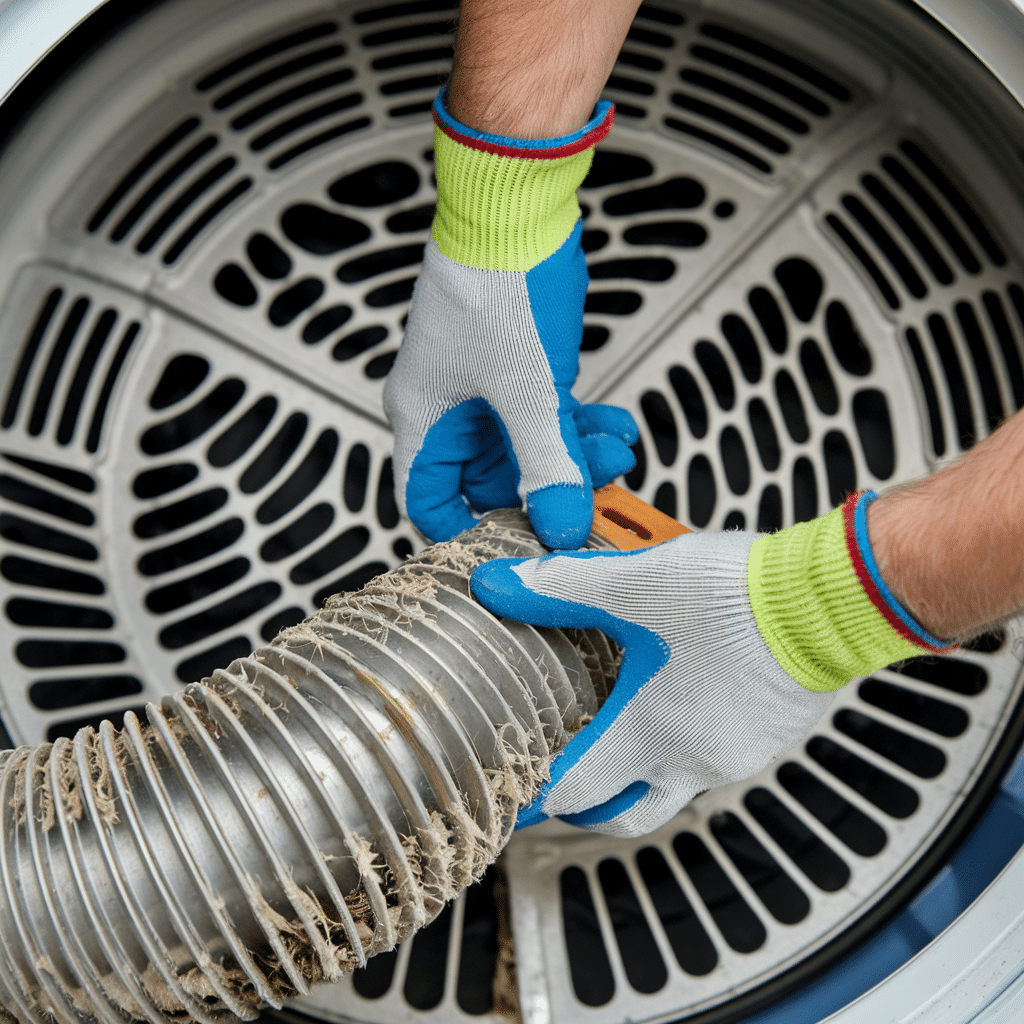
Dryer disconnection and transition duct inspection: We pull the dryer away from the wall, disconnect the power or gas supply following safety protocols, and remove the transition duct connecting the appliance to the wall vent. This short section accumulates heavy lint deposits and often reveals the first evidence of restriction. We inspect for proper duct type (rigid or semi-rigid metal, never vinyl or foil), secure connections, and appropriate length without sagging or compression.
Rotary brush cleaning from both access points: Using specialized rotary brush equipment, we clean the entire vent run from both the interior wall connection and the exterior termination point. The rotating brush dislodges compacted lint while high-volume vacuum equipment simultaneously captures debris, preventing it from redistributing into your home. For vents longer than 15 feet or those with multiple bends, we may need to create additional access points to ensure complete cleaning.
Exterior vent hood service and verification: The termination point receives detailed attention—removing the hood cover, extracting accumulated lint, cleaning louvers or flapper mechanisms, and verifying free operation. We check for pest nesting, weather damage, and proper clearance from landscaping or structures. If the hood is damaged or doesn’t seal properly, we recommend replacement to maintain pest protection and prevent backdrafting.
Internal dryer cabinet lint removal: With the dryer already disconnected, we open the cabinet to access internal components. Using specialized vacuum attachments, we remove lint from around the blower housing, heating element chamber, motor assembly, and internal ductwork. This step, often omitted by basic cleaning services, addresses a significant fire risk that external vent cleaning alone doesn’t resolve.
Airflow testing and thermal sensor verification: After reassembly, we run the dryer through a test cycle while measuring exhaust velocity at the exterior vent. Proper airflow should measure 1,500-2,000 feet per minute at the termination point. Below this threshold indicates remaining restrictions or ductwork design issues. We also verify that thermal safety sensors operate correctly, protecting against future overheating.
System documentation and recommendation report: Quality service includes documentation of what was found, what was corrected, and any concerns requiring future attention. We photograph significant issues, provide vent length measurements, and offer specific recommendations for improving safety or efficiency. This documentation proves valuable for insurance purposes and creates a maintenance history for future service.
The entire process typically requires 60-90 minutes for standard residential installations, with extended time for particularly long or complex vent systems. When you schedule with ACE Appliance Heating and Cooling at (818) 939-4882, you’re investing in comprehensive service that addresses the complete system—not just a quick brush-through that leaves hidden hazards in place.
For homeowners managing other appliance maintenance needs, we offer integrated service appointments covering multiple systems. Our expertise extends beyond dryers to comprehensive washing machine service, refrigerator maintenance, and range and oven care—protecting all the major appliances that keep your Calabasas home running smoothly and safely year-round.
ACE Appliance Heating and Cooling
Get Your Free Quote Today